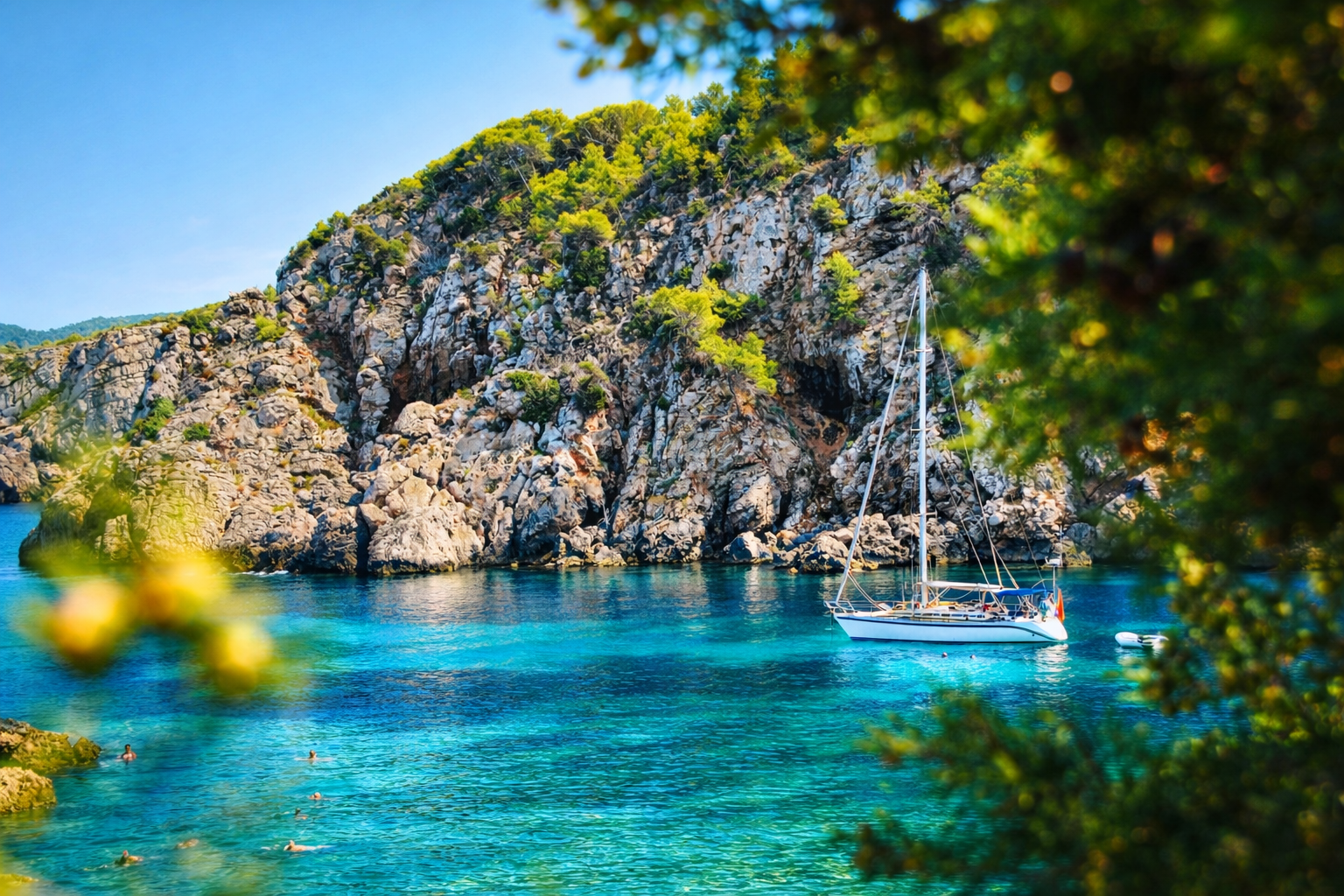
When most people hear "Ibiza," they think of superclubs and sunset cocktails. But strip away the nightlife headlines and you will find one of the best family boating destinations in the Mediterranean. Sheltered coves with water so clear you can count the fish from the deck, calm sandy shallows where toddlers can wade safely, and a coastline that rewards exploration at every turn — Ibiza was practically designed for a day on the water with kids.
This guide covers everything you need to plan a family boat trip in Ibiza for 2026: the best beaches and coves for children of every age, which boats suit families, what to pack, safety essentials, snorkeling tips for young adventurers, and two ready-made routes you can follow from departure to return.
Why Ibiza Is Perfect for Family Boat Trips
Before we get into the details, here is why Ibiza stands out for families on the water:
- Calm, sheltered waters: The south and east coasts are protected from the prevailing westerly winds, creating flat-calm conditions most of the season.
- Shallow sandy coves: Dozens of beaches have gradual, sandy entries — no sudden drop-offs, no strong currents, no hidden rocks.
- Crystal-clear visibility: The UNESCO-protected Posidonia seagrass meadows keep the water remarkably clean, often with 20–30 metres of visibility. Kids can spot fish without even getting their faces wet.
- Short distances: Ibiza is small. Even the longest route in this guide takes under 45 minutes of total motoring. No child has time to get bored or seasick.
- No licence required: For boats under 15 horsepower, you do not need a boating licence in Spain. That opens up a range of small, easy-to-handle boats perfect for family use. Read our full guide on renting a boat in Ibiza without a licence.
- Warm water from June to October: Sea temperatures reach 22–28°C across the summer, so children can splash for hours without getting cold. Check our month-by-month weather guide for exact temperatures.
Best Family-Friendly Beaches and Coves by Boat
Not every Ibiza beach is ideal for families. You want shallow water, sandy bottom, shelter from wind, and enough interest to keep children engaged. These six coves tick every box — and most of them are best reached by boat, meaning you will avoid the parking nightmares and crowded access paths that come with driving.
Talamanca — The Easy Starter
Just five minutes by boat from Ibiza Town's marina, Talamanca is a long, gently curving bay with soft sand and water that stays knee-deep for 30 metres out. It is the ideal first stop if you are testing the waters (literally) with young children who have never been on a boat before. The bay is fully sheltered from most winds, the anchor holds well on sand, and there are beachside restaurants if you need a backup plan.
Best for: Toddlers and first-timers. Minimal boat time to reach it, easy to abandon the plan if someone is unhappy.
S'Espalmador — The Tropical Paradise
This uninhabited island between Ibiza and Formentera is the crown jewel of Balearic family boating. The western shore features a vast, shallow lagoon with powder-white sand and water so clear it looks computer-generated. Kids can wade out 50 metres and still be waist-deep. The natural mud pools on the northern end are an instant hit with children of all ages — they get to cover themselves in "magic" mineral mud and wash it off in the sea.
Best for: All ages. The shallow lagoon is safe for toddlers (with supervision), the mud pools delight 4–10 year olds, and older children can snorkel along the rocky eastern side. The crossing from southern Ibiza takes 25–35 minutes.
Important: You need a licensed boat or a boat with skipper for the open-water crossing to S'Espalmador. The strait between Ibiza and Formentera can have current and passing ferry traffic.
Ses Salines — The Iconic Shallow Bay
Ses Salines beach sits at Ibiza's southern tip and is famous for its long stretch of fine white sand. The water is shallow and the seabed is sandy for a considerable distance — perfect for children who want to swim and play without dropping into deep water. Arriving by boat lets you anchor just off the beach and avoid the notorious parking situation onshore. The Posidonia meadows just offshore are fantastic for a gentle snorkel.
Best for: Ages 3 and up. Great beach for building sandcastles, paddling, and first snorkeling attempts over the seagrass beds.
Cala Pada — The Calm Eastern Gem
On the east coast near Santa Eulalia, Cala Pada is a wide, shallow bay with fine sand and barely a ripple of wave action on most days. The east coast is inherently calmer than the west because it is sheltered from the prevailing wind. A small wooden jetty makes it easy to hop off the boat, and there is a beach restaurant for drinks and lunch. The water stays shallow for a long way out, and the sandy bottom means no hidden rocks to worry about.
Best for: Toddlers and young children. Extremely calm, very shallow, easy access.
Cala Llenya — The Pine-Shaded Cove
A beautiful horseshoe-shaped bay on the east coast, Cala Llenya is surrounded by pine forest that provides natural shade right down to the sand. This is a lifesaver if you have young children who need to get out of the midday sun. The water is calm, shallow, and crystal clear. It is slightly less crowded than the more famous south-coast beaches, even in August.
Best for: Families with babies and toddlers who need shade. The pine trees reach almost to the waterline, giving you natural cover that no parasol can match.
Cala Gracioneta — The Secret Mini-Cove
Tucked behind the larger Cala Gracio near San Antonio, Cala Gracioneta is a tiny cove — no more than 30 metres wide — with impossibly clear water and a small patch of sand. It feels private and enclosed, like your own natural swimming pool. The cliffs on either side block the wind and the shallow rocky edges are home to small fish, crabs, and starfish that children will spend hours observing. There is a rustic beach restaurant perched on the rocks above.
Best for: Ages 5 and up who can swim a little. The cove is small enough that you can see everyone at all times, making supervision easy. Older kids will love exploring the rock pools and snorkeling the edges.
Calm Water Zones: Where to Go on Windy Days
Wind is the biggest variable in family boat planning. Here is a quick reference for finding sheltered water depending on the wind direction:
| Wind Direction | Sheltered Coast | Best Family Coves |
|---|---|---|
| North / Tramuntana | South coast | Ses Salines, S'Espalmador, Talamanca |
| South / Migjorn | North coast | Portinatx, Cala Xarraca, Benirras |
| West / Ponent | East coast | Cala Pada, Cala Llenya, Cala Mastella |
| East / Llevant | West coast | Cala Gracioneta, Cala Salada, Cala Comte |
Rule of thumb: Always head for the coast opposite to the wind direction. If the forecast says southwest wind, head northeast. This simple principle guarantees flat water and happy passengers.
Best Boat Types for Families
Not all boats are created equal when children are involved. Here is what works best:
Small Motorboats (No Licence Required)
Boats under 15 HP that you can rent and drive yourself without any licence. These are typically 4–5 metre rigid-hull boats with a small outboard engine. They are slow (8–10 knots) but stable, safe, and incredibly easy to handle. Perfect for short trips to nearby coves. Budget: approximately 150–250 euros per day.
RIBs (Rigid Inflatable Boats)
RIBs in the 6–8 metre range are the sweet spot for families. The inflatable tubes act as giant bumpers — children cannot hurt themselves on the sides. They are stable, fast enough to cover distance (20–30 knots), and the open layout makes it easy to keep eyes on everyone. Most come with a sun canopy, which is essential. Budget: approximately 300–500 euros per day. A licence or skipper is required for larger models.
Catamarans
For larger families or groups, a catamaran offers unbeatable stability and space. The wide beam means virtually no rocking — a major plus if anyone in the family is prone to motion sickness. The trampolines (nets) at the front are a natural play area for children, and most catamarans have a swim platform at the stern for easy water access. Budget: approximately 600–1,500 euros per day depending on size. Typically comes with a skipper.
Boats with Skipper
If you want to focus entirely on your family and not on navigation, anchoring, and boat handling, hire a boat with a professional skipper. They know the best coves, the safest anchorages, and the sheltered spots on any given wind day. This is particularly recommended for the S'Espalmador crossing or any trip involving open water. Browse all boats with skipper options on EasyBoat.
For a deeper comparison of different vessel types, read our guide on how to choose the right boat in Ibiza.
Age-Appropriate Activities on the Water
The biggest challenge of a family boat trip is keeping everyone entertained — and children of different ages need very different things. This table breaks down what works at each stage:
| Age Group | Best Activities | Best Coves | Key Tips |
|---|---|---|---|
| Toddlers (1–3) | Wading in shallows, playing in sand, splashing from swim platform, spotting fish from the boat | Talamanca, Cala Pada, Cala Llenya (shade) | Keep boat time under 3 hours. Bring familiar snacks. Stay in ultra-shallow water. Shade is critical. |
| Young Children (4–7) | Swimming in calm water, treasure hunts on the beach, collecting shells, first snorkeling with goggles, mud baths at S'Espalmador, jumping off the boat into shallow water | S'Espalmador, Ses Salines, Cala Gracioneta | Bring goggles or a child-sized snorkel mask. Let them "steer" the boat. Create simple games (spot the fish, count the boats). |
| Older Children (8–12) | Snorkeling with full mask and fins, paddleboarding, exploring rock pools, cliff jumping (supervised, low heights), underwater photography, fishing with a hand line | Cala Gracioneta, Cala Salada, S'Espalmador eastern rocks | This is the golden age for boat trips. They are old enough to snorkel properly but still excited by everything. Bring an underwater camera and let them document the trip. |
| Teenagers (13+) | Extended snorkeling, cliff jumping, wakeboarding or tubing (if available), exploring sea caves, freediving, photography and video for social media | Punta Galera (cliff jumping), Es Vedra area, Tagomago Island, Cala Comte | Give them some autonomy. Let them navigate, anchor, or choose the next stop. A waterproof phone case is the best investment you will make. Check out the best snorkeling spots for adventurous teens. |
Snorkeling Tips for Kids
Snorkeling is the single best activity you can do on a family boat trip in Ibiza. The water clarity is extraordinary — on a good day, you can see 30 metres — and the marine life around the Posidonia seagrass meadows is abundant and colourful. Here is how to make it a success with children:
Getting Started (Ages 4–6)
- Start with goggles, not a full mask. Young children often panic with a snorkel mask covering their nose. Simple swim goggles let them put their face in the water and see fish without feeling restricted.
- Use a clear-bottom bucket. For children who do not want their face in the water at all, a bucket with a clear bottom acts as a window into the underwater world. They can lean over the side of the boat or stand in the shallows and see everything.
- Bread attracts fish. Bring a small piece of bread and tear off tiny bits in shallow water. Within seconds, dozens of small bream and mullet will appear. Children go wild for this.
- Stay in knee-deep water. The shallow sandy areas near Ses Salines and Cala Pada have plenty of small fish, crabs, and even starfish — no need to go deep.
Building Confidence (Ages 7–10)
- Invest in a proper child-sized mask and snorkel. Adult masks do not seal on small faces. Buy or rent a dedicated children's set — the difference is night and day.
- Practice in the shallows first. Let them get comfortable breathing through the snorkel while standing in waist-deep water before heading into deeper areas.
- Give them a mission. "Can you find an octopus?" or "Count how many different fish colours you see." A simple goal transforms snorkeling from a technique to an adventure.
- Swim alongside them. A parent snorkeling beside a child, pointing out interesting things, makes the experience ten times better than sending them off alone.
Advanced Young Snorkelers (Ages 11+)
- Add fins. Fins make snorkeling dramatically easier and more fun. Children can cover more ground, dive down to see things closer, and feel like proper underwater explorers.
- Try the rocky coves. Cala Gracioneta and the edges of Cala Salada have rich marine life along the rock walls — wrasse, damselfish, octopus, and moray eels hiding in crevices.
- Underwater camera. Give them a waterproof camera or a phone in a waterproof case. Photographing marine life turns snorkeling into a focused, engaging activity. They will spend twice as long in the water.
- Respect the environment. Teach them not to touch, stand on, or take anything from the sea. The Posidonia seagrass is a protected UNESCO World Heritage ecosystem — look, photograph, but leave everything in place.
Safety Essentials for Family Boat Trips
Safety is the non-negotiable foundation of any family boat day. Ibiza's waters are generally very safe — calm, warm, and free from dangerous marine life — but boats add a layer of responsibility. Here is your checklist:
Before You Depart
- Life jackets for every passenger. Spanish maritime law requires one life jacket per person, and children under 12 must wear theirs at all times while the boat is moving. Confirm that the rental company provides child-sized jackets — do not accept adult jackets for children.
- Check the weather forecast. Wind above 15 knots (Force 4) makes open water uncomfortable for families. Wind above 20 knots — stay on land. Check Windguru, Windy, or the AEMET (Spanish Met Office) app on the morning of your trip.
- Boat briefing. Ensure every adult on board knows how to start and stop the engine, use the VHF radio (channel 16 for emergencies), operate the anchor, and locate the first-aid kit, fire extinguisher, and emergency flares.
- Sun protection plan. Children burn faster on the water because of reflected UV. Apply reef-safe SPF 50 sunscreen 30 minutes before boarding. Bring rash guards, hats with chin straps (hats blow off boats), and UV-protective sunglasses.
- Communicate the plan. Tell your marina or boat rental company where you are going and when you expect to return. Share your live location with someone onshore via your phone.
On the Water
- Engine off before swimming. Always turn off the engine completely before anyone enters the water. Never run the engine with swimmers nearby. Propeller injuries are the most serious risk on recreational boats.
- One adult supervises at all times. When children are swimming, one adult must be on dedicated watch — not reading, not on their phone, not napping. Rotate the duty if you have multiple adults.
- Stay seated while the boat is moving. Children must remain seated and holding on whenever the boat is in motion. No standing, no sitting on the bow rail, no dangling feet off the side.
- Hydration. Dehydration sneaks up fast on the water. Bring far more water than you think you need — at least 1.5 litres per person for a half-day trip. Offer water every 30 minutes, do not wait for children to ask.
- Anchor check. After anchoring, wait a few minutes and check the GPS or a landmark to confirm the anchor is holding. A dragging anchor while everyone is in the water is a serious problem.
Marine Life Safety
Ibiza's waters are very safe. There are no sharks, no dangerous jellyfish (the occasional Pelagia noctiluca appears in August but is more irritating than dangerous), and no venomous fish in the shallows. The main hazards are:
- Sea urchins: Found on rocky seabeds. Wear water shoes or reef sandals when entering the water near rocks.
- Weever fish: Buried in sand in shallow water. Their dorsal spine delivers a painful (but not dangerous) sting. Shuffle your feet when walking on sand to scare them away.
- Sunburn: Honestly, this is the biggest risk. UV reflected off water is intense. Re-apply sunscreen every 90 minutes, even on cloudy days.
What to Pack: The Family Boat Trip Checklist
Packing the right gear separates a great day from a miserable one. Here is the complete list, tested by families who have done this trip many times:
Essential Items
- Reef-safe sunscreen SPF 50 (mineral/zinc-based, not chemical)
- Rash guards or UV shirts for all children
- Wide-brimmed hats with chin straps
- Sunglasses with retention straps
- Water — minimum 1.5 litres per person
- Snacks: fruit, sandwiches, crackers, nothing that melts
- Towels (microfibre dry faster and take less space)
- Change of dry clothes for each child
- Waterproof phone case or dry bag
- Motion sickness tablets (give 30 minutes before departure if needed)
Snorkeling and Swimming Gear
- Child-sized snorkel masks (not adult-sized)
- Swim goggles for younger children
- Fins (if children are aged 8+)
- Water shoes or reef sandals
- Inflatable ring or pool noodle for non-swimmers
- Underwater camera or waterproof phone case
Comfort Items
- Portable shade (beach umbrella or pop-up tent for beach stops)
- Cooler bag with ice packs for drinks and snacks
- Bluetooth speaker for background music
- Small first-aid kit (plasters, antiseptic, vinegar for jellyfish stings, tweezers for sea urchin spines)
- Nappies and swim nappies for babies and toddlers
- A favourite toy or book for the boat ride
Two Family-Friendly Boat Routes
Here are two tried-and-tested routes that work beautifully for families. Both assume a half-day trip (4–5 hours) departing in the morning.
Route 1: The East Coast Explorer (from Santa Eulalia)
This route stays in the calmest waters on the island and is perfect for families with young children or first-time boaters.
- 09:30 — Depart Santa Eulalia marina. Head north along the coast.
- 09:50 — Arrive at Cala Pada. Anchor in the shallows. Let children swim and play in the sand for 60–90 minutes. Snorkel the seagrass edges.
- 11:30 — Short motor (10 minutes) north to Cala Llenya. Find shade under the pine trees. Snack break, more swimming, rock pool exploration along the sides of the cove.
- 13:00 — Optional: continue 15 minutes north to Cala Mastella for lunch at the legendary Es Bigote fish restaurant (book ahead in summer). The tiny inlet is a natural swimming pool for children.
- 14:00 — Begin the return to Santa Eulalia. Total motoring time: approximately 40 minutes across the day.
Route 2: The S'Espalmador Adventure (from Ibiza Town or Playa d'en Bossa)
A bigger day out for families with children aged 4 and up. This route crosses open water to reach the most spectacular family beach in the Balearics.
- 09:00 — Depart Ibiza Town marina or Playa d'en Bossa. Head south.
- 09:15 — Quick stop at Ses Salines beach. Anchor off the sand for a 45-minute swim and snorkel over the Posidonia meadows.
- 10:15 — Cross the strait to S'Espalmador (20–25 minutes). Anchor on the western lagoon.
- 10:45 — Explore the island. Swim in the lagoon, visit the mud pools, snorkel the rocky eastern edge (older children). This is a place you can easily spend 2–3 hours.
- 13:30 — Begin the return crossing. Optional stop at Formentera's Ses Illetes beach for lunch at a chiringuito if time allows.
- 14:30 — Back at the marina. Total motoring time: approximately 60–70 minutes.
Timing tip: Depart in the morning. Ibiza's thermal wind (the "embat") typically builds from the southwest after 13:00–14:00. By heading out early and returning after lunch, you avoid the choppiest conditions. This also means the coves are emptiest when you arrive.
Best Time of Year for Family Boat Trips
The season runs April to October, but for families the window is narrower:
- June: Our top recommendation. Water is 22–24°C (warm enough for children), crowds are manageable, prices are 20% below peak, and the weather is reliably sunny. Read our full seasonal guide for details.
- September: Water is at its warmest (25–27°C), summer crowds have thinned, and prices drop. The occasional autumn weather system can disrupt plans, so watch the forecast.
- July–August: Peak season. Warmest water, best for swimming, but the most crowded coves and highest prices. Book boats well in advance — popular family-friendly boats sell out weeks ahead.
- May and October: Good for experienced families. Water is cooler (18–22°C) and some children may find it too cold for extended swimming. Prices are lowest and coves are empty.
How Much Does a Family Boat Trip Cost?
Budgets vary widely depending on the boat type, season, and whether you add a skipper. Here is a rough guide:
| Option | Low Season (May/Oct) | Mid Season (Jun/Sep) | High Season (Jul/Aug) |
|---|---|---|---|
| Small motorboat (no licence, half day) | 100–150 EUR | 150–220 EUR | 200–300 EUR |
| RIB with skipper (half day) | 250–350 EUR | 350–500 EUR | 450–650 EUR |
| Catamaran with skipper (full day) | 500–800 EUR | 800–1,200 EUR | 1,000–1,500 EUR |
Fuel is sometimes included, sometimes extra (ask when booking). Snorkeling gear, towels, and drinks may also carry a small surcharge depending on the operator. Compare all options and prices on EasyBoat.
Ready to Book Your Family Boat Day?
Browse family-friendly boats in Ibiza — filter by size, features, and budget. Many boats include child life jackets, snorkeling gear, and sun canopies as standard.
Find Your Family BoatPro Tips from Families Who Have Done It
These tips come from real families who have taken boat trips in Ibiza with children:
- Go half-day, not full-day. Unless your children are over 10, a 4–5 hour morning trip is perfect. Full days exhaust young children and usually end with tears.
- Bring more food and water than you think. Sea air and swimming make children ravenous. Pack double what you would for a normal outing.
- Arrive at coves before 10:30 AM. In July and August, popular spots fill up by late morning. Early birds get the best anchor positions and the emptiest beaches.
- Download offline maps. Mobile signal can be patchy along the coast. Download the area on Google Maps before you depart.
- Let children help. Pulling up the anchor, holding the helm (under supervision), choosing the next cove on the map — involvement prevents boredom and creates lasting memories.
- Book a skipper for your first time. Even if you have a boating licence, a local skipper's knowledge of wind patterns, hidden coves, and the best anchoring spots is invaluable on your first family trip. You can go self-drive on the second visit.
- Check for guided family experiences. Some operators run dedicated family snorkeling excursions with marine biologists who turn the trip into an educational adventure. Children love it.
Frequently Asked Questions
At what age can children go on a boat trip in Ibiza?
There is no legal minimum age. Babies and toddlers can go on boat trips, provided they wear an appropriately sized life jacket and you stay in sheltered waters. In practice, children under 2 need very short trips (1–2 hours maximum) with shade and familiar comforts. From age 3–4 onward, children typically enjoy half-day trips. From age 7–8, they can handle a full day on the water.
Do I need a boating licence to rent a boat for a family trip?
Not necessarily. In Spain, boats with engines under 15 horsepower do not require a licence. These small boats are slow but perfectly adequate for exploring nearby coves on the east coast. For larger, faster boats or any open-water crossing (like going to S'Espalmador), you either need a licence or should hire a boat with a professional skipper. See our complete no-licence boat rental guide.
What if my child gets seasick?
Motion sickness is more common in children aged 2–12. Prevention is easier than cure: give a child-appropriate anti-nausea medication (such as dimenhydrinate) 30 minutes before departure, sit them in the centre of the boat where motion is least, keep their eyes on the horizon, ensure fresh airflow, and avoid screens or reading. If a child starts feeling unwell, head for the nearest cove and take a break on solid ground. Choosing calm east-coast routes drastically reduces the risk.
Are there lifeguards at the coves we visit by boat?
Most of the remote coves accessible by boat do not have lifeguards. Larger beaches like Ses Salines and Talamanca have lifeguard stations in summer (typically June–September), but smaller coves like Cala Gracioneta and Cala Mastella do not. You are responsible for supervising your children at all times. This is another reason to keep at least one adult out of the water as a dedicated watcher.
Can I bring a car seat or pushchair on the boat?
You will not need a car seat on a boat — children sit on the boat seats and wear life jackets. Pushchairs are impractical on most boats and most beach-access coves. If you are visiting a sandy beach like Ses Salines, a lightweight beach carrier or sling works better than a pushchair on sand. Leave bulky equipment in the car or at the marina.
Is it safe to swim with toddlers at these beaches?
Yes, provided you choose the right coves and supervise at all times. Talamanca, Cala Pada, and the western lagoon of S'Espalmador have extremely shallow, calm water with sandy bottoms — ideal for toddlers. Avoid any cove with rocky entries or currents. Always hold your toddler's hand or use an inflatable ring in the water. A swim nappy is required for children who are not yet toilet-trained.
What happens if the weather turns bad on the day of our booking?
Most reputable boat rental companies in Ibiza offer free rescheduling or a full refund if the weather makes it unsafe to go out. Ask about the cancellation policy when booking. If the wind is borderline (10–15 knots), the operator may suggest a sheltered route instead of cancelling. Always check the forecast the evening before and the morning of your trip.